.webp) playtestedreview.com
playtestedreview.comThe King Is Watching and the Tyranny of Attention: Why the Royal Gaze Is the Game's Greatest Strength and Its Most Brutal Limitation
Introduction
Most city builders and kingdom management games revolve around resources. Players gather wood, stone, food, gold, and manpower, then convert those resources into larger economies and stronger armies. The challenge usually comes from balancing production chains and responding to external threats.
The King Is Watching takes a radically different approach. While resources still matter, the game's true currency is attention. The central mechanic, known as the King's Gaze, determines which buildings function and which remain dormant. Farms only produce food when watched. Mines only extract ore when observed. Barracks only train soldiers while under royal supervision. The moment the King's attention shifts elsewhere, productivity stops. This mechanic transforms observation itself into a limited resource and creates one of the most unusual strategy systems released in recent years.
At first glance, this appears to be a clever gimmick. However, after several runs, players discover a deeper issue hidden beneath the surface. The real challenge of The King Is Watching is not managing resources, defeating enemies, or constructing a kingdom. The true challenge is dealing with the tyranny of attention. Every decision becomes an opportunity cost. Every second spent watching one building means another building remains idle. Every expansion creates additional demands on a resource that can never fully satisfy the kingdom's needs. This article explores that specific issue in depth and explains how the Royal Gaze transforms an ordinary roguelite kingdom builder into a fascinating study of scarcity, pressure, and decision-making.
1. The Beginning: Why Attention Replaces Traditional Resources
A Kingdom That Refuses to Function Alone
In most strategy games, production chains continue operating after they are established. A wheat farm produces wheat. A mine produces ore. A barracks trains soldiers. The player's role gradually shifts toward optimization rather than direct supervision.
The King Is Watching rejects this philosophy entirely.
Nothing happens without attention.
Workers effectively become extensions of the King's vision. Their productivity depends entirely on whether they are being watched. According to the game's official support documentation, "nothing happens in your kingdom unless you're watching it."
The First Psychological Shift
This creates a major psychological difference.
Traditional city builders reward expansion.
The King Is Watching punishes uncontrolled expansion.
A larger kingdom means:
- More buildings
- More production chains
- More competing priorities
- More demands on attention
The player quickly learns that building something is not the same as operating it.
The true bottleneck is never the building itself.
The bottleneck is the King's ability to watch it.
2. The Early Game Trap: The Illusion of Simplicity
Three Active Tiles
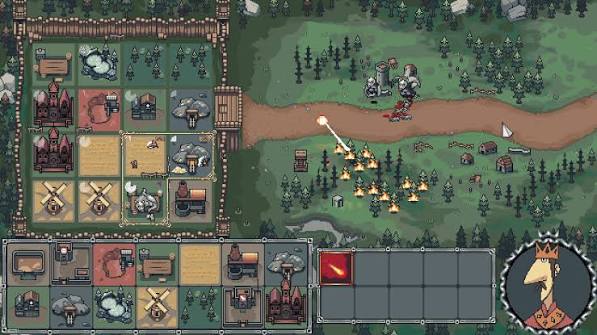
At the start of a run, the King's Gaze covers only a tiny portion of the kingdom. Early versions typically allow only a small cluster of active tiles.
Initially, this appears manageable.
A player places:
- A farm
- A well
- A mine
Then watches all three.
The economy begins functioning.
The situation feels comfortable.
Why New Players Fail
The problem emerges when additional buildings appear.
The player suddenly needs:
- Food production
- Water production
- Military recruitment
- Resource refinement
- Defensive infrastructure
The gaze cannot cover everything simultaneously.
New players often assume that expanding rapidly will solve economic problems.
Instead, expansion usually creates new ones.
Every additional building becomes another demand on the same limited attention pool.
This is the first moment where the game's central tension becomes visible.
3. Attention as a Finite Resource
The Most Valuable Resource Isn't Gold
Most strategy games teach players to prioritize visible resources.
Gold appears valuable.
Food appears valuable.
Stone appears valuable.
Yet The King Is Watching quietly teaches a different lesson.
Attention is more important than all of them.
Without attention:
- Gold stops generating.
- Food stops growing.
- Soldiers stop training.
- Magic stops charging.
The economy collapses.
The Hidden Cost of Every Decision
Whenever the gaze moves, a tradeoff occurs.
Watching farms means not watching mines.
Watching mines means not watching barracks.
Watching barracks means not watching magical production.
The player constantly exchanges one future for another.
This transforms attention into the kingdom's ultimate strategic resource.
4. The Rise of Opportunity Cost
Every Choice Creates a Loss
The brilliance of the gaze mechanic lies in how it makes opportunity cost visible.
In most strategy games, opportunity cost is hidden.
Players understand it intellectually but rarely feel it emotionally.
The King Is Watching forces players to experience it directly.
When the gaze leaves a mine, mining immediately stops.
When the gaze leaves a farm, farming immediately stops.
The consequences become tangible.
The Emotional Effect
This creates a unique feeling of pressure.
The player always feels slightly behind.
Something important is always being neglected.
Something valuable is always inactive.
The kingdom never reaches perfect efficiency.
And that is intentional.
The game is designed around permanent compromise.
5. Midgame Expansion and the Attention Crisis
Growth Creates Complexity
As the run progresses, players unlock additional buildings, production chains, upgrades, spells, and military options.
A larger kingdom should theoretically increase productivity.
Instead, it often increases chaos.
More buildings create:
- More dependencies
- More bottlenecks
- More interruptions
- More gaze conflicts
The economy becomes increasingly fragile.
Why Bigger Is Not Always Better
Many players discover that a poorly planned large kingdom performs worse than a carefully designed small kingdom.
The reason is simple.
Attention does not scale automatically.
Production capacity can double.
Resource requirements can triple.
Military demand can quadruple.
The King's ability to observe remains constrained.
This creates an unusual strategic environment where expansion must be justified rather than assumed.
6. The Military Problem
Soldiers Need Attention Too
Enemy waves are a constant threat throughout every run.
The player needs troops.
Troops require production buildings.
Production buildings require attention.
The result is a direct conflict between economic growth and military readiness.
The False Choice
The game repeatedly forces players into situations like:
Option A
Focus on farms and mines.
Advantages:
- Strong economy
- Resource stockpiles
Disadvantages:
- Weak military
Option B
Focus on barracks.
Advantages:
- Strong defense
Disadvantages:
- Resource shortages
Neither option is ideal.
The optimal solution is constant rotation.
The player must continually shift attention between economic and military priorities.
This creates the frantic rhythm that defines the game.
7. The Gaze Upgrade Dilemma
More Vision, More Responsibility
One of the most important upgrades increases the size of the King's Gaze. Multiple sources recommend prioritizing gaze upgrades because they dramatically increase productivity.
At first, this seems like the perfect solution.
More active tiles.
More resources.
More production.
Problem solved.
The Unexpected Consequence
However, larger gaze areas create new challenges.
Players begin planning larger production networks.
They become more ambitious.
They build more structures.
Soon, the expanded gaze feels insufficient.
The upgrade solves yesterday's problems while creating tomorrow's.
This is a fascinating example of strategic inflation.
The player's needs expand alongside their capabilities.
As a result, attention remains scarce even after major upgrades.
8. The Roguelite Layer Makes Attention Even More Valuable
Randomness Changes Priorities
The King Is Watching incorporates roguelite systems that alter available buildings, upgrades, advisors, enemies, and rewards between runs.
This means players cannot rely entirely on fixed strategies.
Every run creates new attention challenges.
Adaptation Becomes Essential
One run might emphasize:
- Farming
- Resource generation
Another might emphasize:
- Magic
- Specialized units
Another may reward aggressive military production.
Because the gaze remains limited, players must constantly decide where attention creates the greatest value.
The scarcity remains consistent even when everything else changes.
That consistency is what makes the mechanic so powerful.
9. The Philosophical Meaning of the Gaze
More Than a Gameplay Mechanic
Several critics have noted that the gaze mechanic resembles philosophical ideas about surveillance and power. One review even compares it to the concept of the Panopticon, where behavior depends on the possibility of observation.
Whether intentional or not, the comparison is interesting.
The kingdom functions because it is watched.
Workers become productive because observation exists.
The King Is Also a Prisoner
The twist is that the King is not truly free either.
The player appears powerful.
They control the kingdom.
They command the army.
They shape the economy.
Yet they are trapped by their own limitations.
The King becomes a servant of attention.
The entire kingdom depends on a resource that can never fully satisfy demand.
This creates a fascinating inversion of traditional power fantasies.
10. Why the Attention Problem Never Truly Disappears
The Core Design Goal
Many strategy games eventually allow players to overcome their early limitations.
A struggling village becomes a thriving empire.
Resource shortages disappear.
Military strength becomes overwhelming.
The King Is Watching intentionally resists this progression.
Even powerful kingdoms suffer from attention scarcity.
Permanent Tension
The game's greatest achievement is maintaining pressure from the first minute to the last.
No matter how strong the kingdom becomes:
- Attention remains limited.
- Priorities continue competing.
- Tradeoffs remain unavoidable.
- Opportunity costs never disappear.
This ensures that the central mechanic never becomes irrelevant.
The gaze is not merely an early-game challenge.
It is the foundation of the entire experience.
Conclusion
The King Is Watching appears to be a roguelite kingdom builder about constructing farms, gathering resources, training armies, and surviving enemy invasions. While all of those systems are important, they are not the true heart of the game.
The real subject of The King Is Watching is attention.
Through the Royal Gaze mechanic, the game transforms attention into a finite strategic resource that governs every aspect of kingdom management. Buildings do not operate independently. Production chains do not run automatically. Military preparation does not occur passively. Everything depends on where the King's eyes happen to be at any given moment. This design turns ordinary resource management into a continuous series of painful tradeoffs and forces players to confront opportunity cost more directly than most strategy games ever attempt.
What makes this issue so compelling is that it never fully disappears. Players can upgrade their gaze, unlock stronger kings, recruit advisors, and construct increasingly sophisticated kingdoms, but they can never eliminate the fundamental scarcity of attention. There will always be another building that needs supervision, another production chain that requires activation, another military emergency demanding focus. The kingdom grows, yet the pressure remains.
Ultimately, The King Is Watching succeeds because it turns a simple idea into a profound strategic challenge. It demonstrates that the most valuable resource in a kingdom is not gold, food, stone, or soldiers. It is attention itself. Every victory, every defeat, and every decision emerges from the same question: where should the King look next?
Summary: The King Is Watching transforms attention into a scarce resource, making every decision a painful tradeoff.